
The Death of the Queue
Systems, Time, and the Architecture of Waiting

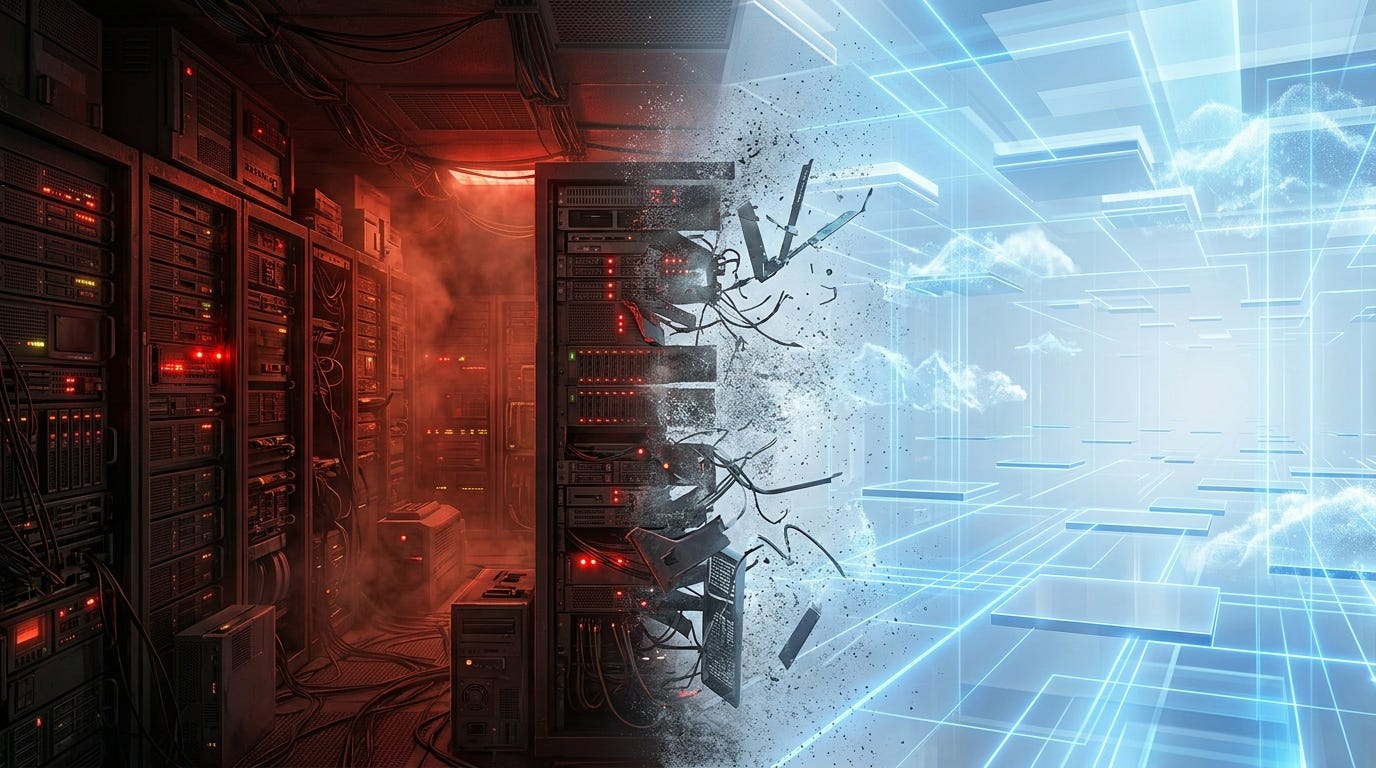
It is 2:00 AM on Black Friday. Inside the network operations centre of a traditional retail enterprise, the atmosphere is a cocktail of adrenaline and dread. Database engineers watch CPU utilisation bars turn from yellow to red as transactional load spikes. Queries are queued, dashboards freeze, and the infrastructure team prepares to manually allocate overflow servers. This is the historical reality of enterprise data management: a constant, adversarial struggle against the sheer physical weight of information.
Now, contrast this with a modern, serverless cloud environment. The same 2:00 AM traffic spike hits, but there is no panic. There are no sirens. Unseen, horizontal infrastructure dynamically allocates thousands of micro-nodes to absorb the impact, processing petabytes of user telemetry in milliseconds, before quietly spinning back down to baseline. The humans sleep.
There is infrastructure so pervasive that it becomes invisible, and the queue is among the most invisible of all. The print spooler that collected documents and released them to the printer in sequence. The batch payroll job that ran at midnight, processing the week’s timesheets and producing Friday’s payments. The nightly ETL pipeline that extracted the day’s transactions, transformed them into analytical records, and loaded them into the warehouse for Monday morning’s reports. The message queue between microservices, absorbing the mismatch between the rate at which one service produced events and the rate at which another could consume them. Queues are everywhere in the architecture of computing, and they are there for a reason that is almost never articulated because it almost never needed to be: systems cannot process the world as fast as the world produces events, and the queue is the structure that absorbs the difference.
That constraint is dissolving. The progression from batch processing to streaming architectures to real-time systems to predictive computation is not a linear speedup — it is a sequence of architectural paradigm shifts, each eliminating a class of queue, each compressing the latency between event and response, and each changing the behaviour of the systems and organisations that depended on the queue it removed. This essay argues that the death of the queue is not merely a technical achievement. It is a reorganisation of how systems relate to time — and a disruption of the functions the queue was performing that had nothing to do with latency and everything to do with governance, accountability, and the provision of temporal space inside which human judgement could operate.
The Queue as Civilisational Technology
Queues predate computers by centuries. The postal clearing house, the banking settlement system, the factory floor work order, the hospital appointment schedule — in each case the queue performs the same structural function: it decouples the rate of production from the rate of consumption, absorbing the temporal mismatch between supply and demand and converting an unpredictable flow of events into a manageable sequence of operations. The queue is, at its most abstract, a promise: the event that entered it will eventually be processed, in order, when capacity is available.
In computing, the batch job was the direct translation of this logic. The constraints were explicit and reasonable: storage was expensive, processing was slow, and the overhead of initiating a computational job was significant enough that amortising it across large collections of work made obvious economic sense. The nightly payroll run processed thousands of employee records in a single operation rather than updating each record the moment a timesheet was submitted. The weekly report aggregated a week of transactions rather than maintaining a continuously updated analytical model. The batch paradigm was not primitive — it was the rational response to genuine constraints. The queue was the correct solution.
What changed was the constraints. Processing capacity expanded exponentially. Storage costs declined to near zero. Network bandwidth increased by orders of magnitude. The economic rationale for accumulating work and processing it in bulk weakened progressively as the fixed costs that made bulk processing efficient disappeared. The batch queue persisted not because it remained optimal but because it was deeply embedded in the architecture of the systems built around it — and because the organisations operating those systems had built their workflows, their staffing, and their decision rhythms around the temporal structure the batch cycle imposed. The queue outlived its rationale, and its persistence became a constraint of a different kind.
Streaming and the Transformation of Latency
The streaming paradigm did not eliminate the queue. It transformed it. Apache Kafka, the distributed event streaming platform originally developed at LinkedIn, is structurally a queue — a durable, ordered log of events to which producers write and from which consumers read. What it changes is the temporal contract: events are available for consumption within milliseconds of production rather than within hours. The batch window — the interval between event generation and event processing — collapses from hours to seconds.
This compression is not merely a quantitative improvement. It is a qualitative shift in what the systems built on streaming infrastructure can do. A fraud detection system operating on batch-processed transaction data can identify fraudulent patterns in yesterday’s transactions; a fraud detection system operating on a streaming pipeline can score each transaction as it clears, before settlement, while intervention is still possible. An inventory management system operating on nightly warehouse data can identify stockouts the following morning; a system consuming point-of-sale events in real time can trigger replenishment orders within minutes of the depletion event. The temporal buffer of the batch queue was not neutral — it was a constraint that foreclosed entire categories of operational response. Streaming revealed the foreclosure by removing it.
Apache Flink extended the streaming paradigm to complex analytical operations: aggregations, joins, pattern detection, and anomaly identification applied to data in motion rather than data at rest. Materialised views updated continuously from streaming sources replace the scheduled queries that once populated batch-generated dashboards. The dashboard that once reported yesterday’s reality begins to report the present moment’s — and the operational decisions it informs become correspondingly more immediate.
Real-Time and Predictive: The Inversion of the Temporal Relationship
The progression from streaming to real-time to predictive is a progression from reactive to proactive — from systems that respond to events after they occur to systems that anticipate events before they fully materialise. This is the point at which the death of the queue becomes something more than latency reduction.
A real-time system responds to an event within milliseconds of its occurrence. A predictive system responds to the probability of an event before the event occurs. A dynamic pricing engine does not wait for demand to manifest in completed transactions — it adjusts prices in response to demand signals extracted from browsing behaviour, search patterns, and inventory levels, acting on a prediction of demand rather than a record of it. A recommender system does not wait for a user to complete a session and then update its model in a nightly batch; it updates its representation of user preference with each interaction, adjusting its recommendations in real time. A predictive maintenance system does not wait for equipment failure — it monitors sensor streams for the precursor signatures of failure and triggers intervention before the failure event occurs.
In each of these cases, the system is operating ahead of the data rather than behind it. The queue has not merely been compressed to zero latency — it has been inverted. The temporal relationship between system and event, which the queue defined as event-first-then-process, has become process-first-then-event: the system acts in anticipation of what the data will confirm. When systems stop waiting, they do not simply become faster versions of what they were. They become systems of a categorically different kind.
Counter-Argument: What the Queue Was Quietly Doing
The case for real-time and predictive architecture is compelling in terms of capability. It requires a significant qualification in terms of consequence. The queue was not only a latency mechanism. It was a buffer — between producers and consumers, between raw events and validated records, between system action and human review. The removal of the queue removes the buffer, and the functions the buffer served do not disappear with it. They become gaps.
Real-time fraud detection acts on incomplete transaction data, before the full context of the transaction is available. Dynamic pricing responds to demand signals before those signals have been validated against known anomalies — flash crashes in financial markets, bot-driven traffic spikes in e-commerce. Algorithmic content moderation makes decisions at a speed that structurally forecloses human review before action is taken. The temporal compression that makes systems faster also makes their errors faster — errors propagate through downstream systems before correction is possible, biases embedded in models act on millions of events before their effects are visible in aggregate, and the actions of automated systems outpace the organisational capacity to understand, let alone contest, what they are doing.
The queue was, in this precise sense, a governance mechanism that nobody designed it to be. The latency it imposed was experienced as inefficiency, and eliminating it was experienced as progress. What was not experienced, because it was never made visible, was the review, the correction, and the human judgement that the latency window made possible. The absence of the queue is also the absence of the pause.
Conclusion: Designing the Deliberate Pause
The queue is dying because the constraints that created it are gone. The nightly batch run will not survive the year? in any organisation that has understood what compute infrastructure makes possible. The question is not whether the queue will disappear but what will replace the functions it served beyond its official purpose.
The most important design question this transition poses is not how to make systems faster. It is how to make systems that are fast enough to be useful and slow enough to be safe — and that distinction, once handled inadvertently by the queue, now has to be handled on purpose. Deliberate pause points — governance layers, human-in-the-loop mechanisms, staged rollout architectures, anomaly detection systems that halt automated action pending review — are the architectural successors to the queue’s accidental governance function. They will not be built by engineers optimising for throughput. They will be built by intelligent entities within organisations that have understood, usually after something has gone wrong at speed, that the queue was doing more than holding their data. It was holding their mistakes long enough to catch them.
References
Google Cloud. “Data lifecycle on Google Cloud.” cloud.google.com. https://cloud.google.com/architecture/data-lifecycle-cloud-platform
Apache Kafka. “Apache Kafka: A distributed event streaming platform.” kafka.apache.org. https://kafka.apache.org/
Apache Flink. “Apache Flink: Stateful computations over data streams.” flink.apache.org. - https://flink.apache.org/
Google Cloud. “Streaming analytics on Google Cloud.” cloud.google.com. https://cloud.google.com/architecture/streaming-analytics
FinOps Foundation. “What is FinOps?” finops.org.https://www.finops.org/introduction/what-is-finops/
Amazon Web Services. “Amazon Redshift.” aws.amazon.com.https://docs.aws.amazon.com/redshift/latest/dg/welcome.html
Microsoft. “Azure Synapse Analytics.” learn.microsoft.com.https://learn.microsoft.com/en-us/azure/synapse-analytics/overview-what-is